

Paid Internships Open Doors for MSU Music Students
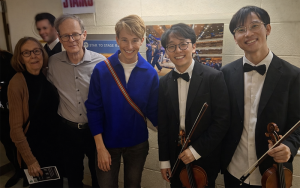
Music alum Carrie Schafer (center) explored an arts administration career path while at MSU through an internship with the Detroit Symphony Orchestra. Since then, she has worked in arts management, as seen here following a Chicago concert by one of her KD Schmid clients, TwoSet Violin (right).
For college students, internships have long been understood as a rite of passage — often unpaid but valuable for gaining experience and professional connections. For many students, however, financial realities can force them to turn down opportunities within the music field simply because they cannot afford to take them.
At the Michigan State University College of Music, that long-standing assumption is being challenged. For the past six years, the College’s Running Start career services and education office has cultivated a network of arts organizations and donors to make paid internships a priority. By covering student compensation directly, the College of Music is opening doors to career preparation that might otherwise remain closed.
Music alum Carrie Schafer is one student who benefited from this approach. Schafer returned to school to earn a master’s degree in trumpet performance but pivoted to arts administration. She is now an artist coordinator with international agency KD Schmid, but she recalls a time when the Running Start helped by linking her to a paid internship with the Detroit Symphony Orchestra (DSO). During the spring and summer of 2025, she worked on community engagement projects with DSO Director of Engagement Clare Valenti.
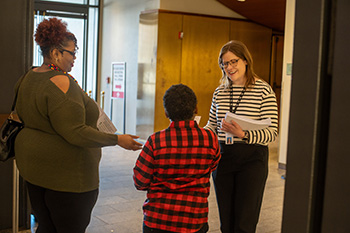
Detroit Symphony Orchestra Director of Engagement Clare Valenti enjoys working with MSU College of Music staff to bring students to the DSO for experience in orchestra administration. Valenti, seen here with a parent and child during a DSO Relaxed Open Rehearsal, connects MSU students to project tasks that help build a new skill set that they want to learn.
“The value of interning with the DSO was enormous. I learned a lot from how Clare Valenti treated everyone she worked with; humble, kind, informed, patient, and forgiving,” she said. “I saw firsthand how much effort goes into events throughout the year, and I often reflected on how I took all of that for granted in my performing days. It’s actually very challenging to accommodate all needs, ideas, budgets, attitudes, and conversations.”
For Valenti, the partnership with the College of Music has been equally meaningful.
“I’ve really enjoyed working with all the students and all of the staff at the College of Music,” she said. “It’s a relationship that’s been built over many years, and it’s something that I think is really unique.”
Valenti works within the DSO’s learning and engagement department, which connects the orchestra with communities across Detroit through performances, education programs, and collaborative projects. Interns from MSU support this work by assisting with programming, planning, communications, and coordination across a wide range of initiatives.
“I think catering and tailoring the project tasks to a new skill set that students want to learn is extremely important. We try to find opportunities within projects that align with their career goals,” Valenti explained.
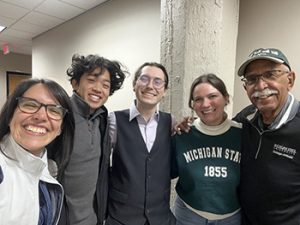
Director of Career Education and Music Entrepreneurship Emily Henley (second from right) works closely with MSU Community Music School – Detroit Assistant Director Paola Smith (left) to place Music interns where they receive pay through the college while getting real-world experience. With them are two Music interns on the job and MSU donor George Hill who serves on the CMS-D Community Advisory Board and as a member of the College of Music National Leadership Council.
The Running Start Office’s commitment to paid internships and experiential learning is stronger than ever, extending well beyond orchestral settings. There are currently four internship programs that create a total of 10 to 15 paid internships per semester. One of the programs, the Detroit Arts Leadership Experience (DALE), is funded by the MSU Federal Credit Union Dream Fund and allows students to gain paid, direct experience in community-based music education.
Eli Rachlin, a senior jazz studies major in trumpet performance, completed a DALE internship at the MSU Community Music School–Detroit in 2025. His work included community outreach, on-site support for students, and administrative assistance.
“I pursued the internship for both the experience and the financial compensation, but without pay, I likely would have sought employment elsewhere,” Rachlin shared. “Being compensated to gain practical and administrative skills was especially meaningful to me, as those skills will directly inform how I begin branding and marketing myself within the music industry after I graduate.”
Back at the DSO, Schafer credits both Running Start and Valenti for helping her navigate a pivotal moment in her career.
“I’m so grateful that I was given resources from Running Start to make the best of my situation,” she said. “I really appreciated that this internship threw me straight into meetings, professional communications, and the world of an orchestral community and engagement department.”
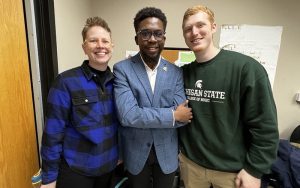
From left, Music students Lee Duling, Jauron Perry, and Eli Rachlin interned together at the MSU Community Music School – Detroit. Rachlin said being compensated to gain practical and administrative skills was meaningful to him.
She also valued being treated not as a temporary observer, but as a contributing professional.
“I think some of the best things we can do for students is to put them in many more real-life situations while they are in college,” Schafer added.
Valenti is candid about why paid internships matter, both for students and for the organizations they serve. Having built her own career following mostly unpaid internships in her early years, she sees how those models can limit access and reinforce inequity.
“I think the tide is turning with a lot of our higher ed partners, but Michigan State was really the first that said this is a paid opportunity,” Valenti said. “Students shouldn’t have to make the choice between being able to take care of themselves or have these opportunities that are important to career growth.”