

A Voice for Artistry and Access: Kenneth Thompkins Honored at DSO’s Classical Roots
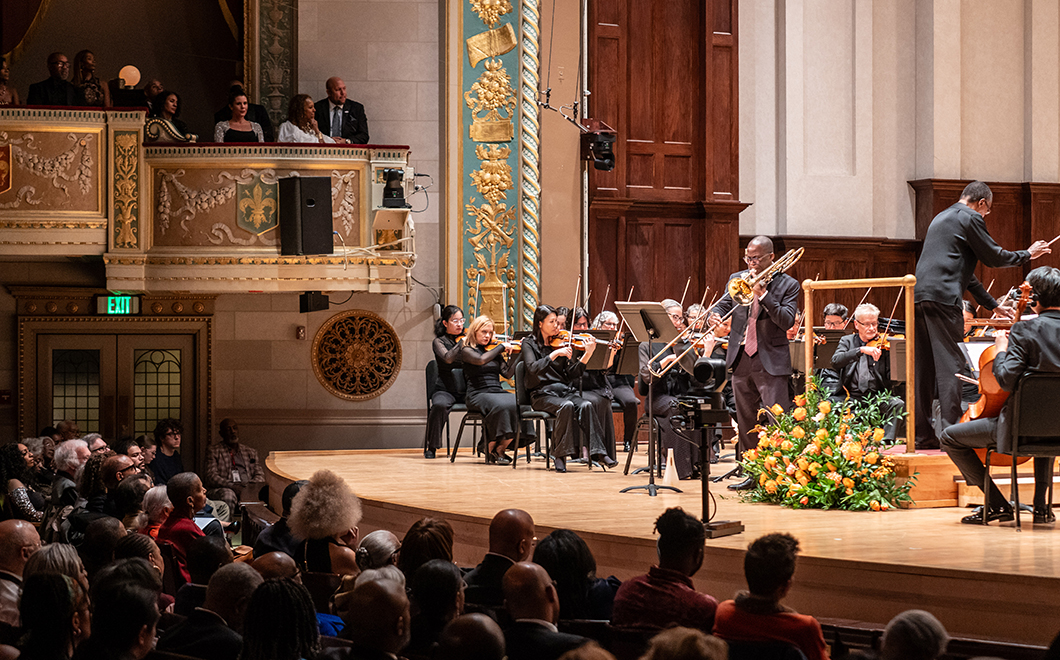
Detroit Symphony Orchestra honors
Kenneth Thompkins, MSU associate professor of trombone.
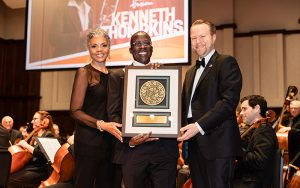
On stage at Orchestra Hall in Detroit, Kenneth Thompkins is honored with a plaque by the Detroit Symphony Orchestra’s Board Chair Faye Alexander Nelson and President and CEO Erik Rönmark. Emily Crombez Photography
Detroit’s Orchestra Hall stage has been familiar to Kenneth Thompkins for more than three decades, but this year, he was cast in a different spotlight when the Detroit Symphony Orchestra’s Classical Roots Celebration honored him for his artistic achievement, enduring commitment to nurturing young musicians, and advocacy for advancing equity in classical music.
The longtime DSO principal trombonist retired from the orchestra to become associate professor of trombone at the Michigan State University College of Music. He said the call from Classical Roots was an honor he never saw coming.
“I was shocked and humbled by it, and it was something totally unexpected for me.”
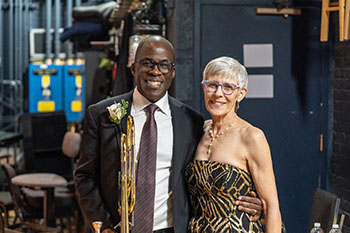
A happy Kenneth Thompkins was joined backstage by his spouse, Jana Thompkins, following his performance of Carlos Simon’s Troubled Water.
In early March of this year, Thompkins received recognition at the 25th Annual Dr. Arthur L. Johnson–Honorable Damon Jerome Keith Celebration, a signature part of DSO’s Classical Roots which has uplifted African American composers, educators, and community leaders since 1978. For Thompkins, the event carries particular meaning because early in his career he was the third person ever named a DSO African American Fellow.
“That’s how I initially came to Detroit in 1992,” he said. “I played in the fellowship program for two years. In general, the musicians coming in have fifteen or so weeks of performing with the orchestra. They get lessons and other performance opportunities, and funding for taking on professional auditions.”
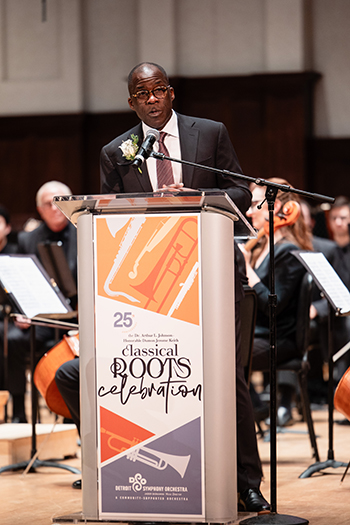
Kenneth Thompkins addresses the audience in Orchestra Hall, speaking eloquently about advocacy for musicians of color while accepting the annual Classical Roots honor. Emily Crombez Photography
After completing the fellowship, he returned to Detroit as principal trombone in 1997, spending the next 27 years not only performing at the highest level but mentoring aspiring orchestral musicians – fellows and non-fellows alike. His approach blends musicianship, conversation, thoughtful critique, and steady support.
“I feel very passionate about mentoring and helping younger musicians along their path. That’s why I’m teaching,” he explained. “The trombone is the vehicle, but really, it is about connecting with other people and helping them along their path, whatever their passions or interests.”
For many musicians of color, mentorship from someone who has navigated similar spaces carries added weight. Thompkins understands the isolation that can accompany the intense, individual journey of pursuing orchestral performance.
“There are a lot of different elements of interaction that happen there, and it’s positive because anyone that becomes a professional musician understands that most of the time it’s a solitary journey,” he said. “To receive feedback is extremely important; to have an accurate mirror held up to what you’re doing.”
Thompkins is heartened by the talent he sees rising today.
“I’m encouraged that I see more and more musicians of color who are performing at an extremely high level, and that are capable of playing in professional orchestras,” he said. “That is a fact. Period.”
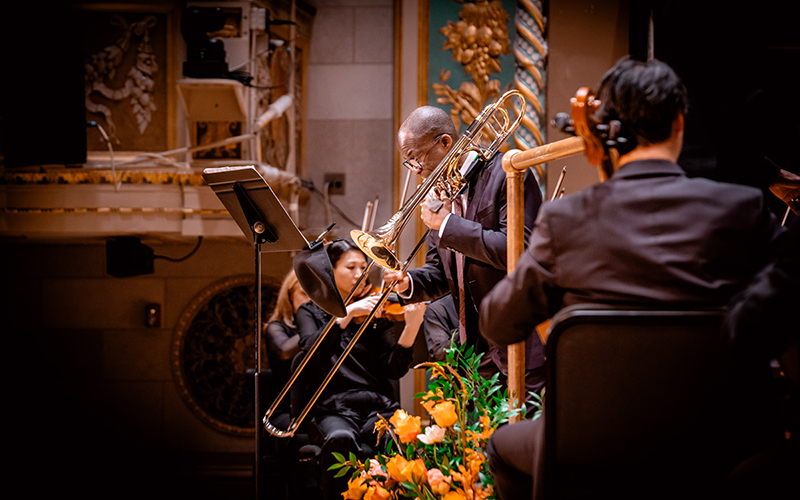
Following the DSO’s 25th Annual Arthur L. Johnson–Honorable Damon Jerome Keith Celebration, Kenneth Thompkins returned to the Orchestra Hall stage for a special performance. He retired as principal trombone in the DSO in 2024 and now teaches at the MSU College of Music. Photo by Sarah Smarch
But encouragement does not mean the work is done. He believes the systems governing auditions and tenure still fall short of true fairness.
“Ideally, we want a blind audition process from beginning to end, so the identity of the candidate is not known.”
He has watched with concern as orchestras sometimes hold auditions but leave positions unfilled, or they invite finalists for trial weeks that reveal their identity prematurely.
“Unconscious bias is a real thing. It perverts the audition process,” he said.
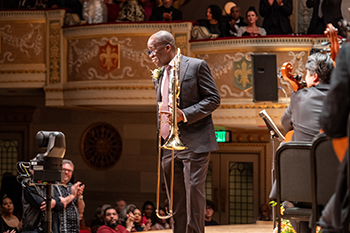
Kenneth Thompkins’ performance in Detroit on March 12 was received by the audience enthusiastically, and it carried particular meaning for him because early in his career he was the third person ever named a DSO African American Fellow. Photo by Sarah Smarch
Thompkins is active within Black professional networks and advocates for eliminating practices that undermine equitable access. But his view extends beyond auditions: creating real opportunity starts long before a young musician ever steps onstage, and he knows this because of the access he realizes he had as a child.
“I had access. I had general music class when I was in elementary school. I had access to an instrument in third grade. I had a tremendous amount of access to music and to ensembles and to teachers,” he explained.
That early access, he believes, must be intentionally created by institutions devoted to music education.
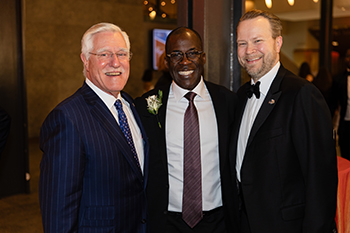
Flanking guest of honor Kenneth Thompkins at the Classical Roots festivities prior to the concert was MSU College of Music Dean James Forger (left) and Detroit Symphony Orchestra President and CEO Erik Rönmark. Emily Crombez Photography
“You have to be conscious and purposeful in creating different pathways of access and opportunity to young musicians across the board.”
And while that work continues, Thompkins remains focused on the students in front of him—musicians of every background who share a drive to grow.
“Eager, motivated students are fun to teach,” he said, “because they are equally invested in their future.”
As the gala drew to a close, Thompkins returned to the Orchestra Hall stage to perform Carlos Simon’s Troubled Water, a work he played a role in bringing to life. The sold-out audience responded with a standing ovation.
He described the moment simply: “I’m happy. It was a good performance.” But he also admitted it was almost overwhelming in the best possible way.
“For me, the whole experience was like sensory overload. It was a fantastic experience, really. I mean, getting to play with that orchestra is fantastic. It’s a great orchestra.”
In the end, the evening served as both a recognition of a storied past and a reminder of the work still ahead. It was a celebration of artistry, mentorship, and the power of opening doors for the next generation.