

A Passion for Place, Pedagogy, and Performance
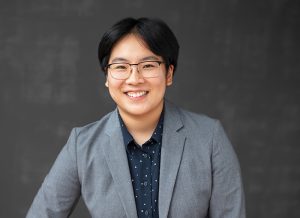
Following the completion of her doctoral degree at the University of Michigan and teaching experience at Oberlin, Sylvie Tran will join the faculty of the Music Theory Area at MSU in Fall 2025.
This fall, Sylvie Tran will join the college as an assistant professor of music theory, bringing with her a unique blend of scholarly curiosity, performance experience, and a deep commitment to inclusive, student-centered teaching.
Tran focuses her research on the intersections of music, place, and identity—particularly in American classical music. Her current work explores portrayals of the American West in twentieth- and twenty-first-century concert music, examining how music can reflect and reveal the dynamics of broad themes like race, gender, and landscape.
“In many ways, it feels like this research is a reflection of myself,” Tran said. “I get to study music inspired by my home region, that I grew up hearing on the radio and playing in orchestra.”
Growing up in Albuquerque, New Mexico, and immersed in music from an early age, Tran credits the local classical radio station and her experiences in the city-wide youth orchestra with sparking her curiosity. Her flute teacher, who incorporated music theory into lessons through ear training and improvisation, laid the groundwork for what would become a lifelong passion.
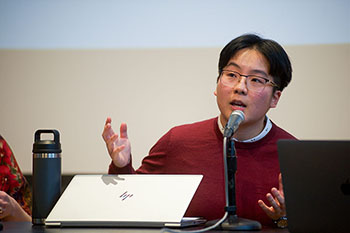
Sylvie Tran gives a presentation on an opera last December. She first became connected to the MSU College of Music through teaching a short-term course in spring 2024.
But it wasn’t until her undergraduate studies at UC Santa Barbara that Tran realized music theory could be more than just Roman numerals and chord labels. A pivotal classroom “aha” moment while analyzing Robert Schumann’s “Widmung” opened her eyes to the expressive power of theory.
“Our professor beautifully highlighted how the texture and harmony of the piano part reflected the text,” she recalled. “It helped me understand both the music and the meaning of the text better, and it also encouraged me to think of music theory as a tool for performance.”
That moment set her on a path toward academic research, eventually leading her to pursue graduate studies at the University of Michigan and a career in music theory.
Tran’s teaching philosophy is rooted in the belief that every student brings valuable musical experiences to the classroom. She emphasizes belonging, adaptability, and contextual understanding in her pedagogy.
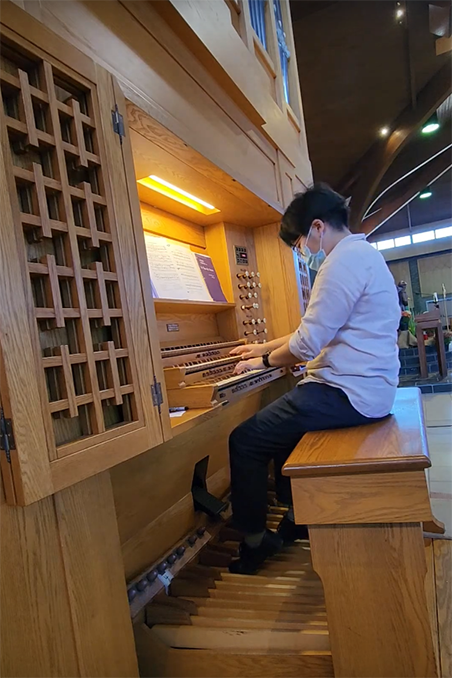
Sylvie Tran first began with music by playing flute, but she says whether within or outside her professional life, she enjoys trying new things. Here, she practices organ at the St. Francis of Assisi Catholic Church in Ann Arbor.
“My biggest priority as a teacher is that my students feel a sense of belonging, not only in the classroom, but in their academic and musical lives,” she said. “I don’t make assumptions about what my students do or do not already know, but I do assume that every student comes into a class with a variety of musical experiences and strengths.”
Tran also integrates students’ own musical interests into her teaching, often drawing on the repertoire they are performing or listening to. She doesn’t shy away from complex or controversial works, encouraging students to think critically about the cultural and historical contexts behind the music.
“To me, music theory isn’t just notes or chords, but how notes and chords can tell us a story,” she explained. “I think it’s important for students to have the tools to talk about whatever that story might be, for any piece they perform or listen to.”
Her connection to MSU began in Spring 2024, when she taught a short-term course at the College of Music. The experience left a lasting impression.
“It was such a positive teaching experience because of the students,” Tran said. “They were curious and driven, and they had such different musical backgrounds, experiences, and goals that made the class rich and interesting.”
She also found a welcoming and collaborative academic environment among the faculty and graduate students.
“During my campus visit, I got the sense that there’s a vibrant community of music theorists at MSU, and that there’s a substantial culture of collaboration across the College of Music,” she said. “I feel very fortunate and grateful for the chance to join this community.”
Current faculty in the Music Theory Area are looking forward to Tran joining them this fall. They see in her an educator with a knack for relating to students.
“Sylvie Tran brings a passion for integrating current research into her teaching, and she has a unique ability to reach students and really make the classroom a place where everyone belongs and can learn,” said Cara Stroud, associate professor and incoming chair of the Music Theory Area at MSU. “I’m so glad we can welcome Sylvie to our faculty because she brings a fresh perspective to teaching music theory.”
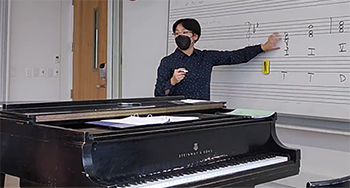
Sylvie Tran says that part of her teaching philosophy is understanding that each student brings their own connection to music into the classroom. Her new colleagues on the MSU faculty praise her ability to create a strong sense of belonging which creates a vibrant learning environment.
Outside the classroom, Tran remains an active musician. She sang in a community chamber choir while completing her PhD, regularly reads chamber music with friends, and has taken up instruments like the organ and recorder “with varying levels of proficiency,” she joked.
“I think staying active as a musician—even though I rarely perform in a professional capacity anymore—keeps me grounded in what I teach,” she said. “It reminds me that most of my students are approaching music and music theory from a practical perspective.”
Tran also brings a spirit of curiosity and experimentation to her personal life, which she sees as closely tied to her teaching.
“I love to try new things and learn new skills, even though that means I’m bad at them to start with,” she said. “And I emphasize that in my teaching: learning new skills can be hard, and it takes time and persistence to develop them.”
As she prepares to join the MSU College of Music, Tran is eager to contribute to a dynamic and evolving field—and to help students find their own “aha” moments along the way.