

Championing Epistemic Justice in Music Education

In her new book, Juliet Hess, professor of music education in the Michigan State University College of Music, explores how music educators can better serve students from of minoritized identities – including racialized, gender expansive, trans, disabled, neurodivergent, LGBQ+ individuals, and those experiencing poverty – by recognizing and validating their knowledge and lived experiences.
Juliet Hess has long been a voice for equity and inclusion in the classroom. Now, the professor of music education at the Michigan State University College of Music is set to publish her latest book which presents practical ways to honor and embolden knowers across a range of minoritized student populations.
Cultivating Epistemic Justice in Music Education: Honoring Minoritized Knowers, which is set to publish by Routledge on February 17, 2026, brings together years of research, philosophical inquiry, and classroom experience to offer a transformative framework for music educators.
“At its base, epistemic justice is about doing right by people as knowers,” said Hess. “Every person comes to the classroom with knowledge and experiences, and that includes teachers and learners. So, it’s about trying to figure out how to do right by people across the full range of identities in the classroom.”
The book explores how music educators can better serve students from of minoritized identities – including racialized, gender expansive, trans, disabled, neurodivergent, LGBQ+ individuals, and those experiencing poverty – by recognizing and validating their knowledge and lived experiences. Hess argues that some of the most harmful practices in education are epistemic in nature, stemming from how teachers recognize or fail to recognize students as knowers and the credibility or lack thereof assigned to student perspectives.
“The ways that we think about who is deemed credible and who is not, and who doesn’t even clock on someone’s radar as a knower, needs to be figured out so that every student feels like their perspective is valued,” she said.
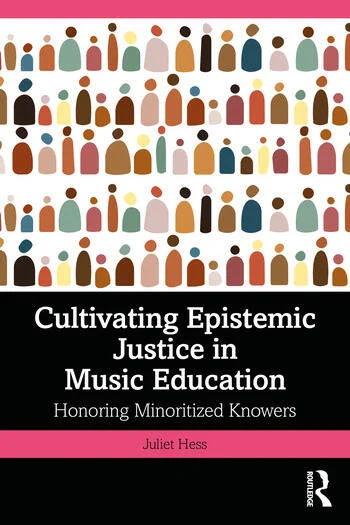
Hess’s journey toward this work began with anti-racist scholarship and expanded into broader anti-oppression themes. Around 2020, she began focusing on epistemic injustice, a concept that now anchors her new book. Drawing from empirical research and philosophical scholarship, Hess structures each chapter to first identify injustices in music education and then offer practical, justice-oriented solutions.
“My intent with this book is that, even though it is philosophical, it is practical so that teachers will be able to find some of these concepts applicable to things that they’re doing in the classroom,” she said. “Teachers are some of my favorite people. We try to do right by our students, and I want this book to help teachers make sure that our actions align with the things we intend.”
At MSU, she works with students at various stages of their educational journey, from undergraduates to PhD candidates, and her research informs her approach with students. Hess said she often uses age discrimination as a way in to explaining that this happens across the full range of identities. College age students tend to be familiar with people assuming they are young and therefore not yet knowledgeable.
“Discussion with students about age discrimination is relatable to them,” Hess explained, “and it allows me to bring together anti-racist work with disability studies, neurodivergence, trans and LGBTQ folks, and trying to figure out ways that all of the wisdom and experience that people bring to the classroom can be acknowledged, honored, and celebrated.”
Hess’s work and growing influence in her field is recognized by her peers in the MSU College of Music and across the United States. Dean James Forger praised her impact on students and the field of music education overall.
“Through her research, Dr. Hess has become one of the foremost experts on inclusion in the classroom,” he said.
As chair of the Music Education area in in the college, Ryan Shaw sees firsthand how Hess’s expertise and approach to the courses she teaches broadens what the music education program at MSU offers.
“I can’t think of anyone who brings the expertise on these important issues quite like Juliet,” Shaw said. “What’s great for the music education area is that she weaves her ideas into her undergraduate coursework, her graduate teaching, and her doctoral advising.”
Hess is known for challenging her students to rethink their assumptions and embrace uncertainty. She believes that future music educators benefit from questioning preconceived notions and learning to adapt to the unique needs of their students.
“The future teachers I teach often come into my classes with firm ideas of what they’re going to do when they are a practicing teacher, and I really want to unsettle that,” she said. “I want them to move from certainty to uncertainty so that by the time they graduate, they realize that they have a bunch of tools, but it is better to wait to meet the students who are going to be in front of them before making any decisions about what it’s going to look like.”
Rather than prescribing “best practices,” Hess advocates for contextual practices or approaches that consider the specific needs and circumstances of each classroom.
“My hope is that students learn to be critical thinkers on their own, to have their own ideas and to figure out what they think, not what I think.” Hess said. “I’m not a big fan of critique for the sake of critique. I’m a big fan of critique for the sake of figuring out how we do this well and better.”