

MSU jazz professor awarded prestigious Guggenheim Fellowship


Michael Dease, professor of jazz trombone in the Michigan State University College of Music, has been named a Guggenheim Fellow in the 100th anniversary class of the prestigious fellowship. Dease, named an MSU Red Cedar Distinguished Professor in May, is one of 198 individuals selected from nearly 3,500 applicants, recognized for his prior achievements and exceptional promise.
The Guggenheim Fellowship, established in 1925, is one of the most prestigious awards available to artists, scholars and scientists. Recipients receive monetary stipends to pursue independent work, and because these stipends are awarded under the freest possible conditions, more than 19,000 fellows in total have been able to make significant contributions to their fields over the past century.

As an in-demand performer and recording artist, Michael Dease maintains a hectic pace while always providing time to perform for local crowds on campus, including the annual Jazzy Little Christmas concert featuring the MSU Professors of Jazz.

Michael Dease performs in 2019 with MSU Jazz Studies graduate Luther S. Allison who has gone on to perform in Lincoln Center Jazz Orchestra programs.
“Michael Dease is a standout in his field, and this recognition from the Guggenheim Foundation shows that Michigan State is a place where exceptional talent and hard work can thrive,” said MSU President Kevin M. Guskiewicz. “He’s not only an incredible musician but also a creative thinker whose work bridges disciplines and sheds light on meaningful issues in our world.”
Dease’s upcoming project, titled “MacNolia,” is an extended-length album of original music scored for jazz chamber orchestra. He has composed five of a planned 28 pieces for the album and plans to complete writing this fall with recording slated for spring 2026. Inspired by the life of MacNolia Cox, the first Black American to finish in the top five of the National Spelling Bee, the music will feature thematic works based on poems by award-winning writer A. Van Jordan.
“Growing up as a biracial person who could sometimes pass as white in a very segregated southern city, I learned a lot about burdens and struggles of the Black community from the Black side of my family as well as the deep-seeded racist secrets from the white side of my family,” Dease explained. “MacNolia and her family faced extreme racism from the moment they arrived at the National Spelling Bee in Washington, D.C. Despite these hardships, MacNolia was unflappable, advancing easily to the competition finals.”
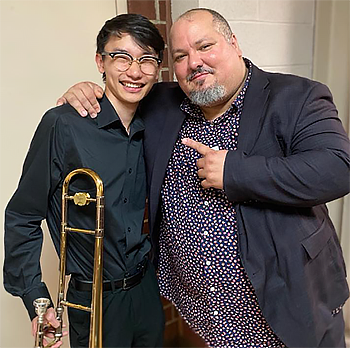
In 2023, Michael Dease celebrated one of his students, Andrew Kim, who was the winner of the American Trombone Workshop National Solo Jazz Competition.
Her story and Jordan’s writings based on it inspired Dease to share it through music, noting that it is relevant today because so many girls have their own MacNolia story. To bring it to life, Dease plans to combine traditional big band instrumentation with strings, winds, horn and percussion to create pairings, shadings and inflections that capture Jordan’s imagery.
“I’ve always felt that life as a jazz musician humbles me every day as I learn from brilliant musical colleagues and students from all generations and backgrounds,” Dease shared. “The roster of 2025 Guggenheim Fellows illuminates contributions from great minds in over 50 fields! I feel honored, grateful and encouraged by the foundation and inspired by my peers to reach for deeper meaning in my work. I also thank my mentors in the Michigan State University College of Music, University Distinguished Professor Rodney Whitaker and Dean Jim Forger, for believing in my work for nearly 15 years.”
Dease’s dedication to education is evident in his approach to this ambitious project. His fellowship can also serve as motivation for his students.

In January 2023, Michael Dease traveled to Atlanta to receive the Ellis Marsalis, Jr. Educator of the Year Award at the Jazz Education Network Conference, and while there he enjoyed some time with MSU Professor of Percussion Gwen Dease and their children.
“One need only look to the jazz trombone students of Michael Dease to see his excellence as an artist-teacher. They are winning major competitions and performing professionally all over the world,” said MSU College of Music Dean James Forger. “The ambitious and thoughtful project he is taking on during his Guggenheim Fellowship year models artistic excellence for his students while addressing important societal issues through the power of music. We celebrate the impact of his incredible artistic achievements.
One of the things that makes this ambitious project exciting for Dease is the potential to inspire others, especially his students. He wants them to see the rewards that come from this kind of challenging work.
“I think career modeling is super effective, second only to a dedicated work ethic. Most of my journey has been driven by drawing inspiration and direction from the beacons in my field. My hope is that those encountering my music and research will feel validated in pursuing their artistic dreams in spite of any obstacles,” Dease said. “Specifically, this project strives to reveal the layers of despair caused by injustice and capture those feelings sonically through a unique approach to orchestration. Sharing stories like this is intended to educate our community and generate understanding for those who may be silenced or misunderstood. I want my students to know that connection passion, research, and leadership is deeply rewarding on many levels.”