

Music School Recruiting in the Modern Age
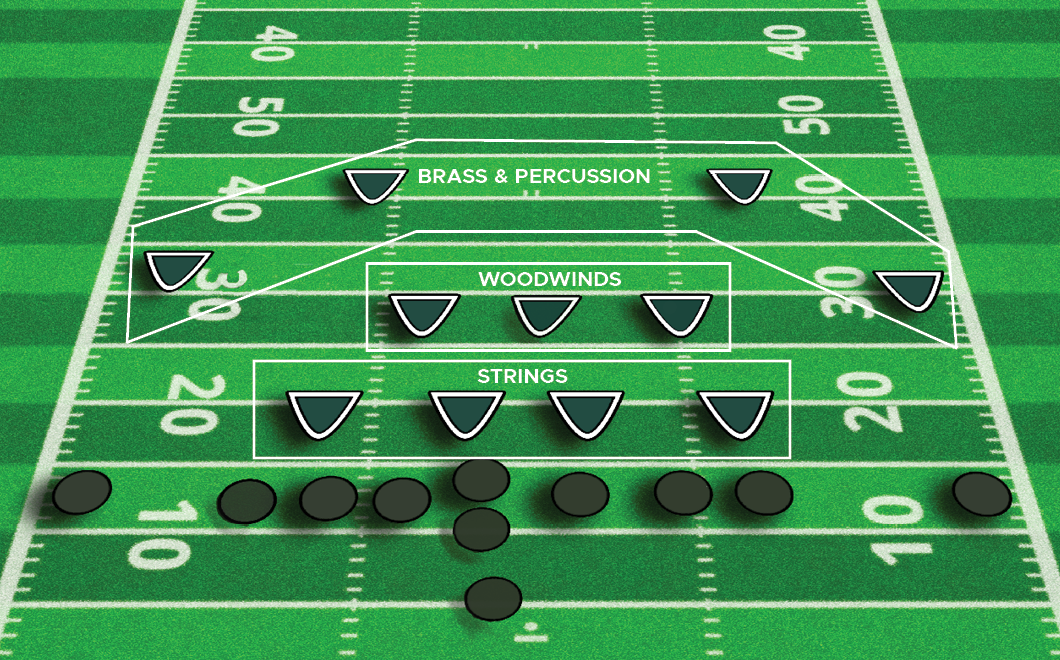
A little-known fact about higher education degree-granting programs in music: there is no official ranking of them in the United States. While national rankings influence student recruitment in many academic disciplines, music programs rely heavily on faculty reputation, facilities, scholarships, and word of mouth among professionals and peers.
Unlike many academic programs, music schools also face a challenge similar to that of a football team. Success depends not simply on recruiting the most talented individuals, but on building an entire roster. A football team cannot succeed with great wide receivers but no quarterback. Likewise, orchestras, wind symphonies, jazz ensembles, and choirs require talented musicians filling many different roles. The quality of those ensembles plays a major role in shaping a school’s reputation.
“We can’t just recruit one student. We have to recruit an entire class,” explained Ben Ebener, director of admissions at the Michigan State University College of Music. “Sometimes when a full ride scholarship is needed to successfully recruit, it puts us in a situation where we have nothing left for anybody else.”
That reality can create what Ebener calls a talent gap. If much of the college’s scholarship funding is committed to a handful of highly sought-after students, fewer resources remain available to recruit the many musicians needed to build strong ensembles across the college.
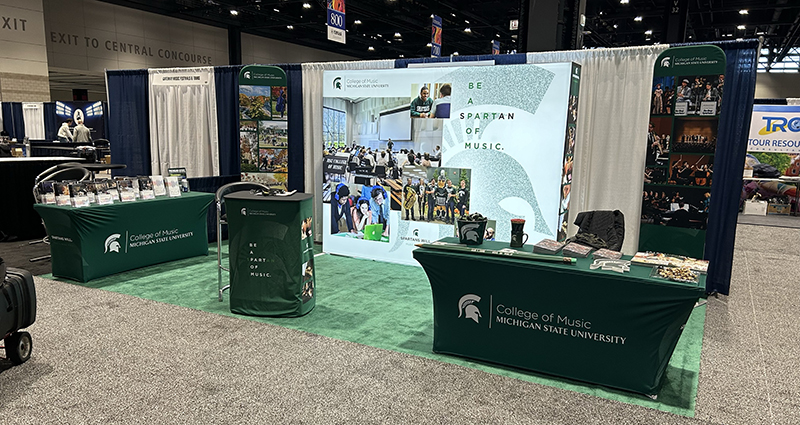
As football recruiters do, College of Music Director of Admissions Ben Ebener and Assistant Director Grimaldo Robles work year-round to fill a roster of talent to maintain skilled large ensembles year after year. While information booths and recruiting fairs help them meet strong music applicants, it is the availability of ample scholarship dollars that tend to determine if top students choose MSU Music.
Even with Michigan State’s accomplished faculty and expanded facilities, scholarship support often remains the deciding factor in a highly competitive recruiting landscape.
“Many students considered to be at the highest level among their peers really want to be here, but another school has made it more affordable. Maybe we just have to get closer and then that student will choose us, but if we do that two or three times, then we don’t have much left to offer the very good musicians who make up the rest of the ensemble.”
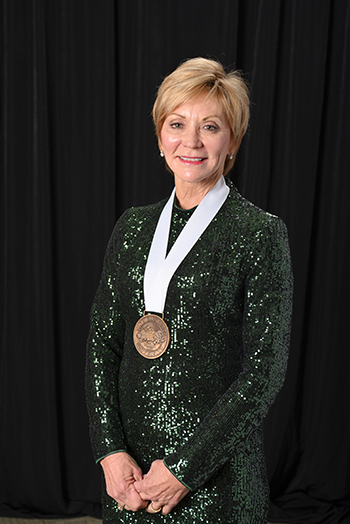
Bonnie Larson is a member of the College of Music National Leadership Council. Her gifts to MSU span several areas of the university, and her support of the arts at MSU and in Detroit are a hallmark of her generosity. She was recognized with the Philanthropist Award by the MSU Alumni Office in 2023.
Those realities help explain why the MSU College of Music has set an ambitious $30 million goal during the university’s “Uncommon Will, Far Better World” campaign. For Ebener, faculty members, and future students, support from donors makes a significant difference. People like Bonnie Larson understand that mission.
Larson has a history of supporting arts programs through donations and roles on boards of the Detroit Symphony Orchestra, the Detroit Institute of Arts, and more. In fact, she created the Bonnie A. Larson Aspiring Musicians Endowment to provide scholarships and program support for students attending classes and summer programs at the MSU Community Music School in Detroit, an outreach division of the MSU College of Music.
Larson also supports the College through service on its National Leadership Council. Her most recent scholarship is the Bonnie A. Larson Music Scholarship Endowment.
“For me, if I can focus on endowment, I feel that the gift is a lasting gift,” Larson said. “The endowing of scholarships for music students is a very good fit for me. I know how difficult the recruiting is for promising students, and I felt that this would be helpful in attracting students to Michigan State.”
Larson began building the endowment with a gift of a lower amount. It is through her bequest that she plans to grow it to its full potential.
“Through my estate gift, my hope is that I will be able to endow that scholarship enough that it will support tuition for a student to go four years through school. That’s my ultimate goal,” she said.
Larson explained the importance of legacy and how her children, as they continue to be notified of the good that the Larson Endowed Scholarship is doing, can feel the love their mother had for MSU, the College of Music, and the education of young musicians. Her appreciation of legacy stems from her parents, Donald and Cecile Borgeson, who were very active volunteers at MSU. In fact, Larson set up an endowment in the Eli Broad College of Business to honor them and their dedication and support of MSU.
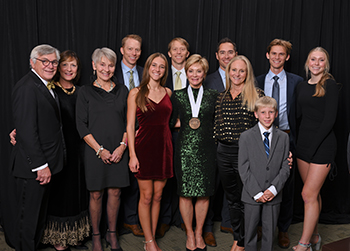
As she has done following the example set by her parents, Donald and Cecile Borgeson, Bonnie Larson knows that her children will carry on a legacy of giving. Her family celebrated with her when she received the 2023 Philanthropist Award at the MSU Alumni Grand Gala.
“Any money in a scholarship makes a difference to a family,” Larson said. “So, I think there’s room for all kinds of scholarships, especially endowed scholarships that the college can depend on year after year. To attract the caliber of student we want, we need more scholarships.”
Four-year scholarships can be especially impactful because they allow faculty to recruit differently, using substantial scholarship support to attract exceptional students while preserving other resources to strengthen the broader student body and ensemble experience.
“If I could give every performance studio and academic area a Bonnie Larson Scholarship so that we can lock in one excellent undergraduate for the next four years, that would be ideal,” Ebener said.
Like a successful football program, a great music school needs its star performers and talented people throughout the roster. Scholarships help make that possible, and gifts like Larson’s provide a lasting investment in the student experiences that define the MSU College of Music.