

Two for Rachmaninoff: A Musical Partnership Years in the Making
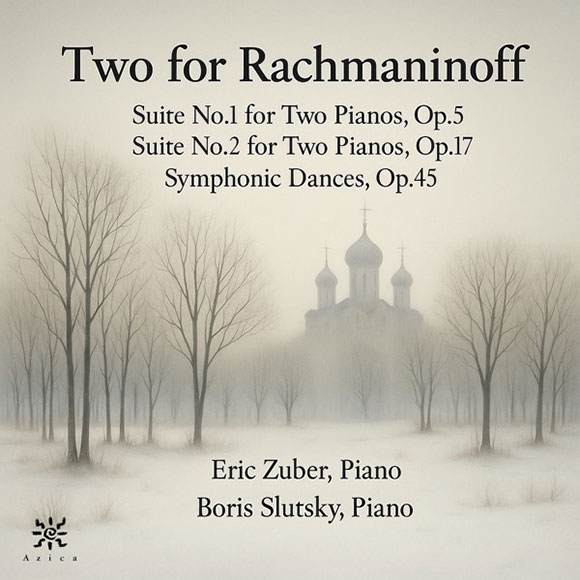 When pianists Eric Zuber and Boris Slutsky sit down at two grand pianos, they bring with them more than technical command and a shared love of Sergei Rachmaninoff’s music. They bring a relationship that began in a teaching studio and has evolved into a musical partnership now captured for the first time on record.
Their new album, Two for Rachmaninoff, released by Azica Records, features Rachmaninoff’s complete works for two pianos, spanning the composer’s entire creative life. For Zuber, an assistant professor of piano in the Michigan State University College of Music, the project is both a professional milestone and a deeply personal one.
“Playing with Boris Slutsky, my teacher of over 20 years, significantly eased the challenges inherent in recording this material,” Zuber said. “Given our long-standing musical relationship—much of my musicianship shaped under his guidance—we could naturally respond to each other’s timing and phrasing with minimal rehearsal or explicit communication.”
Rachmaninoff’s two-piano works are famously demanding, not just for their technical difficulties but for the interpretive flexibility they require. Zuber noted that recording these works adds another layer of complexity.
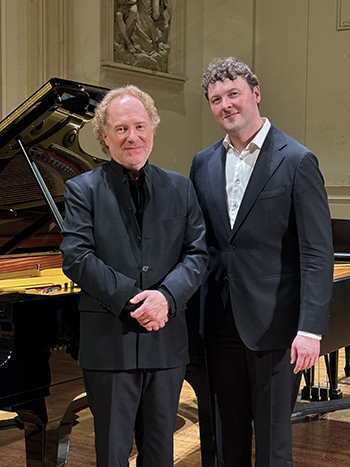
Two for Rachmaninoff marks the first time Eric Zuber, right, recorded with his mentor, Boris Slutsky. The duo went on a mini-tour in the U.S. following the release of the album.
“Beyond the technical and musical difficulties, recording two-piano works involves several unique challenges,” he said. “First, due to the piano’s direct attack, there is less margin for error in timing than when collaborating with instruments that have a more gradual onset of sound.”
The first challenge for any dual piano recording, Zuber noted, is technical. In a studio, slight imperfections that may fly by unnoticed during a live performance are laid bare by the microphone.
“In a resonant concert hall, minor synchronization issues might go unnoticed,” Zuber said. “On a recording, these imperfections stand out clearly.”
That challenge, he added, is amplified by the nature of Rachmaninoff’s writing, which relies heavily on rubato and expressive flexibility. The depth of musical understanding between Zuber and Slutsky proved essential.
The repertoire itself was carefully chosen, both for its musical scope and its symbolic resonance. Rachmaninoff’s two-piano works trace the arc of his career, from the youthful First Suite to the late, searching Symphonic Dances.
“Like many pianists and listeners, I’ve always felt deeply connected to Rachmaninoff’s music,” Zuber said. “For me, it’s his sincerity of expression, emotional honesty, and exceptional craftsmanship in writing for the piano. Hearing these works together is fascinating, as they encapsulate his entire evolution as a composer.”
Still, the decision to record this music was motivated as much by personal history as by repertoire.
“I chose this repertoire in part because I wanted to create a recording with my beloved teacher with whom I share a deep love for this music,” Zuber said. “Having studied with Boris from age 11 through much of my musical formation, it felt meaningful to preserve a record of his exceptional artistry.”
That relationship resonates clearly in the finished recording. Reviews have consistently highlighted the rapport between the two pianists. BBC Music Magazine noted that “their musical bond is seamless, the execution of their musical ideas always in sync.” Textura described the album as “as much about the relationship between its pianists as the works performed,” adding that “the teacher-student relationship has grown into a mutually enhancing partnership.”

With great attention to every detail, the performance and production team for Two for Rachmaninoff recorded at Fairchild Theatre. From left, Boris Slutsky, Azica Records owner/producer/engineer Alan Bise, and Eric Zuber.
Zuber said that this recording with Slutsky and his previous album, The Young Chopin (also released on Azica) enhance his work as an educator at Michigan State University. With his students, he emphasizes that the process extends far beyond playing the notes. It involves planning, consistency, and collaboration with engineers and producers.
“Having the experience of recording a professionally produced album is invaluable in my role as an educator,” he said. “I am able to guide students through the full scope of what it means to bring a recording to life, from the earliest conceptual stages to the final product.”
What he can share with his students now includes the broader, often less visible aspects of a studio project. It connects again to that major difference between live performance and studio recordings, and on that topic, Zuber sees transparency as essential.
“Recording has a way of exposing details that can easily go unnoticed in live performance,” he said. “Being able to speak candidly with students about these realities helps demystify the process.”
In Two for Rachmaninoff, that honesty, both musical and personal, is front and center. It captures not only the breadth of Rachmaninoff’s vision, but an artistic trust built over more than two decades at the piano.