

Music Education Alum Has Major Impact in First Full-time Position
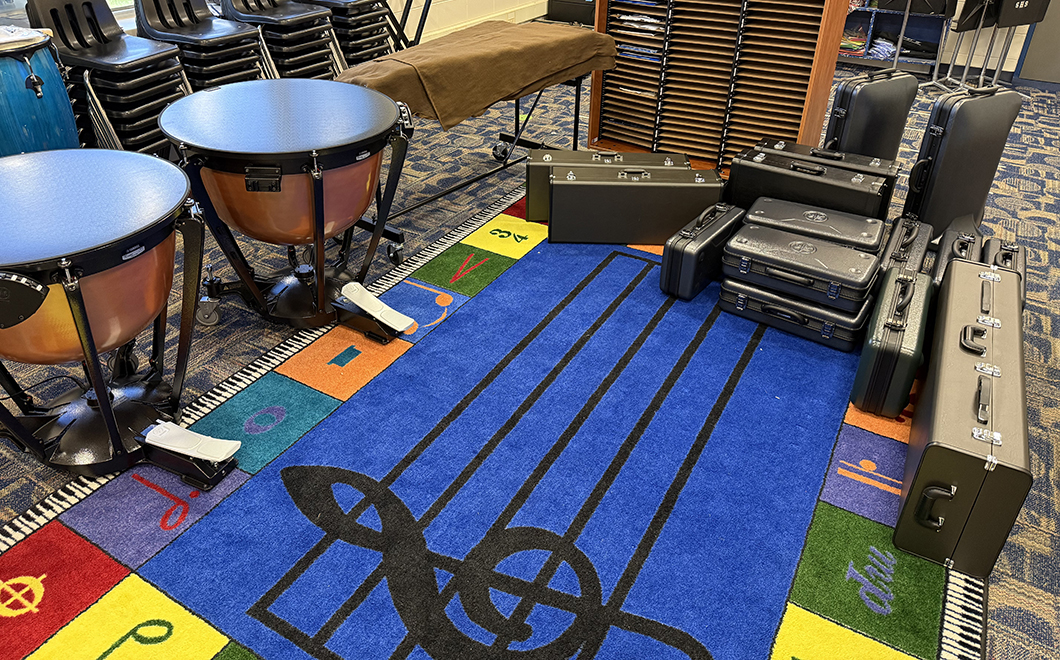
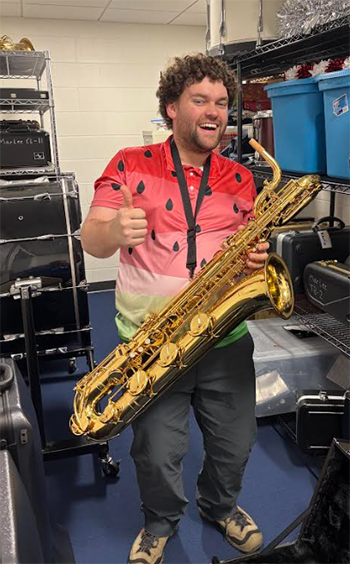
2025 Music Education graduate Matthew Weber took a position at a small rural school, and with a grant transformed the music program in his first year of teaching.
In his first year as a full-time music teacher, Michigan State University alumnus Matthew Weber has already accomplished something many educators take years to achieve: securing a state grant that is transforming opportunities for his students and strengthening music education for his students and community.
For Weber, who earned his bachelor’s degree in music education in 2025, the decision to pursue the grant came almost immediately after stepping into his new role at Mar Lee School near Marshall, Michigan. Rather than taking time to settle in, he immediately recognized the huge needs of his program and acted quickly. It showed a level of initiative that stood out to his former professors.
“His success speaks well of our program because he knew how to couch his request for funding in pedagogical terms that the grantors found compelling,” said MSU Professor of Music Education Karen Salvador. “More importantly, Matt is proving to be an innovative and entrepreneurial teacher. He took a position in a place where the music program was in rough shape, and he figured out how to improve it.”
At schools in more remote areas like Mar Lee with limited resources, the impact of music education can be especially meaningful. Weber’s successful grant application is expanding access to instruments, classroom materials, and instruction opportunities. Late in his first school year, for example, he held an elementary school band concert where students used their instruments, new chairs, and music stands in public for the first time.
“Almost every time aides are in my room, they say things like, ‘the previous teacher never played music on the piano, never played CDs for us, never showed us examples on the smart board.’ So, for me in my first year, I decided there’s no one else here besides me. I am the music teacher for the district, and we need to have fun with this,” Weber said. “When we have our concerts in the gym, we need to make it a homey environment that also has a little bit of school spirit.”
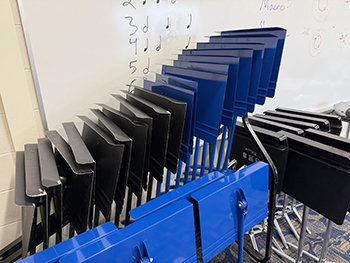
Among many needs in his new school, Matthew Weber ordered new music stands, some in the school’s blue to help raise school spirit.
To get there, Weber had to jump directly into a process for which he had not prepared. He was, after all, simply expecting to find his way in a position and school that was completely new to him. One day, however, he noticed something in an email from the Michigan Music Education Association (MMEA). It was a grant offered by the Michigan Department of Education, and Weber was excited to realize it could be used for visual arts which would fulfil another need at his school.
Time was running out, so with the help of his school’s business manager, he applied for the grant. He had nothing to lose, so he asked for everything he thought a program like his could use – and it was a lot. The small music room in his school, after all, was a converted computer lab with only a rug on the floor when he arrived.
Within a few months, after one semester on the job, news arrived that Mar Lee would receive the full amount for which Weber applied – more than $109,000. In addition to the stands and music-appropriate chairs, he has purchased all new band instruments, including two timpani drums and a xylophone. Better pricing than he initially found when applying for the grant allowed him to buy six alto saxophones instead of the initial two he hoped for, as well as an additional tenor saxophone, more trumpets, a baritone saxophone, and two horns. He wisely budgeted for repair of these instruments, and he was able to purchase a new sound system for the music room.
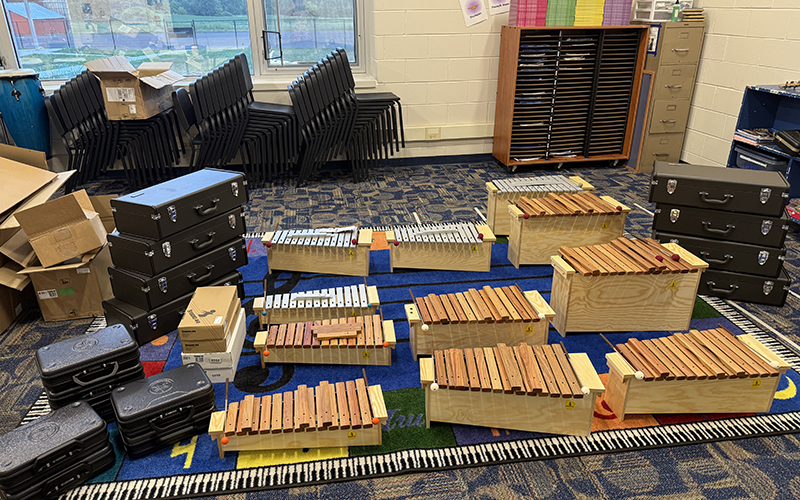
With a grant of more than $100,000 – that his former professor played a role in creating – Matthew Weber took a small music program that only had choral work to one with a full array of instruments.
“Providing these quality instruments for these students has been amazing. Including the elementary items, I have received three giant bundles of awesome stuff,” Weber said. “I’ve noticed a lot of the students at our school really value a hands-on approach, and I love having them able to do that with instruments instead of being limited to singing.”
What Weber did not realize until after he began receiving these prized new items is that one of his MSU professors had a strong connection to the very funds now benefitting his students. Associate Professor of Music Education and Chair of the Music Education Area Ryan Shaw was directly involved in researching and reviewing language that led to the grant.
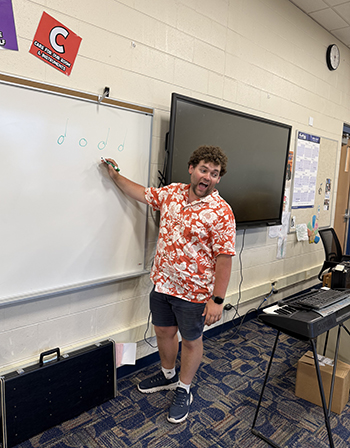
Music Education alum Matthew Weber is an enthusiastic teacher, and his can-do spirit is changing the music experience dramatically for students at Mar Lee School near Marshall, Michigan.
Since joining the faculty of the MSU College of Music in 2018, Shaw has served as government relations coordinator for the MMEA – the same organization that informed Weber of the funding opportunity. Shaw and others from the MMEA collaborated with Michigan State Senator Erika Geiss and other lawmakers for several years to advance legislation that would create a statewide requirement for K-5 art and music in all schools, for all Michigan students. Michigan is one of fewer than ten states that does not have such a requirement in place.
“That effort has proven synergistic with my scholarly work because I’m able to do research and then use it to advocate for things at the state level,” Shaw explained. “Broadly speaking, kids have access to music and art in Michigan, but when times get tough and budgets are tight, those things can be cut. We are trying to create a mandate that would help that not happen.”
After multiple rounds of negotiations among legislators over several years, the efforts finally resulted in more than three million dollars approved in the 2025-2026 Section 33 K-5 Visual Arts and Music Programs budget. As with many new grants, early knowledge and use of funds can be a challenge. It took a while for word to spread, which is how Weber found himself against a tight deadline as he began his new position. Shaw was not surprised to hear about the resourcefulness Weber showed.
“I had Matt in the upper-level instrumental pedagogy courses, both instrument techniques courses and then what we call ‘teaching instrumental music’ that students take right before their student teaching semester,” Shaw said. “We always thought of him as one of our sharpest students.”
That has proven fortunate for one small school in rural Michigan. Weber’s efforts have translated into new opportunities for his students to participate, create, and connect through music. It is no small feat, and the research and advocacy efforts from the faculty who prepared him for his position illustrate the deep impact of music education at MSU.
“I think that this is the kind of teacher we want to see,” Salvador said. “We prepare teachers who embed themselves in a community and make music happen for the kids.”