

The Research Behind the Art
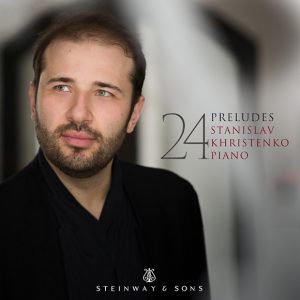
The latest release from Steinway artist and MSU Assistant Professor of Piano Stanislav Khristenko is an in-depth exploration of the history of preludes. It was recorded on Steinway’s Spirio piano at the MSU College of Music.
When Stanislav Khristenko joined the faculty of the Michigan State University College of Music in the fall of 2024, he brought with him a reputation for expressive and thoughtful performances. Something less visible yet fortunate for MSU piano students is that his approach is one of disciplined research of the kind exhibited in the creation of his latest album, 24 Preludes.
Released in June by Steinway & Sons, where Khristenko has recorded since 2014, the creation of 24 Preludes required a deep dive into the prelude, a genre that stands on its own with a rich history. Preludes were originally viewed as improvised introductions to larger works, but composers and performers began to consider them individually. This was especially true following the popularity of J.S. Bach’s Well-Tempered Clavier, a set of 24 preludes and fugues covering all major and minor keys.
Khristenko explained that he organized his first recording with Steinway & Sons around a single genre, the fantasy. Staying in the same genre for an entire album intrigued him, so he decided to return to it by examining preludes this time.
“Preludes captivated me because they represent one of the most concentrated forms in all of piano music – short in duration yet capable of extraordinary depth and complexity,” he said. “When I think of the most beloved pieces ever written for the piano, a remarkable number of them are preludes. The prelude has attracted composers across every era, and the tradition of writing sets of 24 – one in each key – gave me a natural framework.”
Khristenko decided that for his new recording he would select his own set of preludes, 24 in total by 24 different composers. This is where the musician’s research becomes paramount.
On 24 Preludes, the selections are “divided into four groups of six representing the span of five centuries, starting with one of the earliest examples of the genre dating back around 1650,” he said. “The last six are drawn entirely from works composed within the past 25 years. That structure allowed me to trace the evolution of the prelude as a form while also presenting a genuine variety of styles.”
Within institutions like the MSU College of Music, the full scope of music study involves performers and academicians. At MSU, for example, Music Theory, Musicology/Ethnomusicology, Composition, and Music Education are fields in which highly regarded faculty research everything from broad issues in education to nuanced histories, dissections, and creations of music. What Khristenko’s latest effort illustrates, however, is that being a serious performer and educator requires research effort as well. It is a winning formula that results not only in excellent recordings but in the advanced education of the next generation of performers.
“Performance and research are not separate pursuits; they continually inform and strengthen one another,” said College of Music Associate Dean for Graduate Studies and Creative Endeavors Derrick Fox, who is also the associate director of choral programs and professor of choral music. “Research gives artists the context to make thoughtful and intentional musical choices, while performance brings that inquiry to life in ways that can inspire audiences and shape the next generation of musicians.”
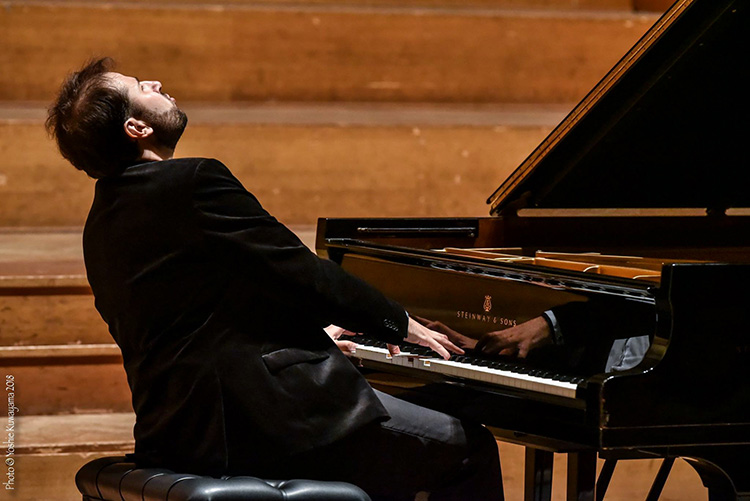
Photo by Yoshie Kuwayama
Khristenko decided to record this new album on Steinway & Sons’ innovative Spirio piano. The fact that the College of Music owns one of them made it easier.
“Spirio is a technology developed by Steinway over the past dozen or so years that captures every detail of what happens at the piano during a performance, with the ability to reproduce and refine it afterward,” he explained. “I was fortunate to be involved in its early development and among its first recording artists. While Spirio is perhaps best known for allowing Steinway pianos to play back pre-recorded performances by Steinway artists, it has also fundamentally changed how audio recordings can be made.”
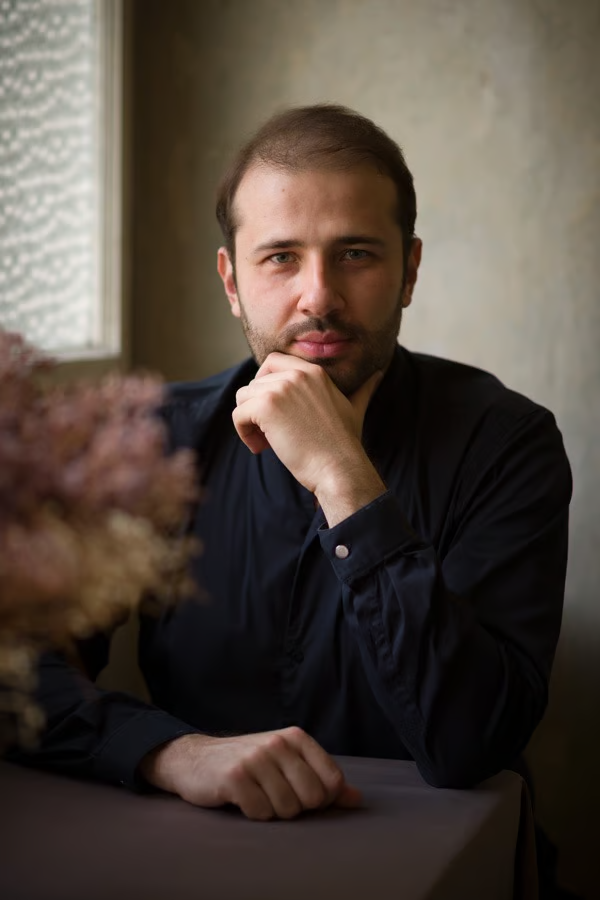
Stanislav Khristenko joined the MSU Music faculty in 2024 and says his colleagues and students have made the college feel like home.
For artists, Spirio alters the traditional way of recording which typically involves multiple performances carefully edited into the final product, even in recordings labeled as live. With 24 Preludes, each piece was recorded in a single take. Only minor adjustments of individual notes occurred afterward.
“Spirio returned creative control to me as the performer. Every musical decision in the editing process was mine to make,” Khristenko said.
While technically and artistically freeing, this also placed an enormous responsibility on the artist. The program he chose with works by multiple composers added to the complexity.
“In a work by a single composer, you inhabit one musical world for an extended period of time; the style, the technique, the emotional language all remain consistent. With a program like this one, you must transition almost instantaneously from one composer’s sound world to another’s, each demanding a completely different technical and emotional approach,” Khristenko said.
In other words, Khristenko did not allow himself to settle into a comfort zone of one work by one composer. He had to do it all, which required a massive amount of preparation. According to Khristenko, his colleagues and students played no small part in shaping his efforts, starting with his recital of a prelude program.
“This album was created during my first year at MSU, and the preludes program was actually my first recital as a member of the faculty here. Performing in front of such wonderful colleagues and my own students for the first time was an extremely stressful experience, but it was also a deeply rewarding one,” he said. “I was also delighted to discover that MSU had recently acquired a Steinway Spirio piano, which meant I could record right here on campus rather than traveling to New York as I had done for previous recordings. That was a wonderful convenience, and it made the whole process feel very much rooted in my new home.”
A reflection of his new home is Khristenko’s recording of MSU Professor of Composition Zhou Tian’s Prelude, the first recording of the piece written by his colleague whose office is on the same floor. The piece, Khristenko explained, was commissioned by Salon de Virtuosi in New York in 2024, and it is inspired by an imaginary ballet with several contrasting sections and a hint of Chinese folk elements.
Now that he has completed two years of teaching at MSU and released an album that is so engrained with Spartans Will, Khristenko can reflect on what this campus has come to mean to him.
“Being part of the MSU College of Music has been a tremendous source of inspiration. Some of the prelude choices on this album were directly inspired by my work with students here, which speaks to how deeply my teaching and my artistic life have become intertwined,” he said. “Our keyboard area has a truly unique environment – defined by the mutual support among colleagues and the exceptionally high level of our piano students – and that atmosphere has fed my own creativity in ways I didn’t anticipate.”