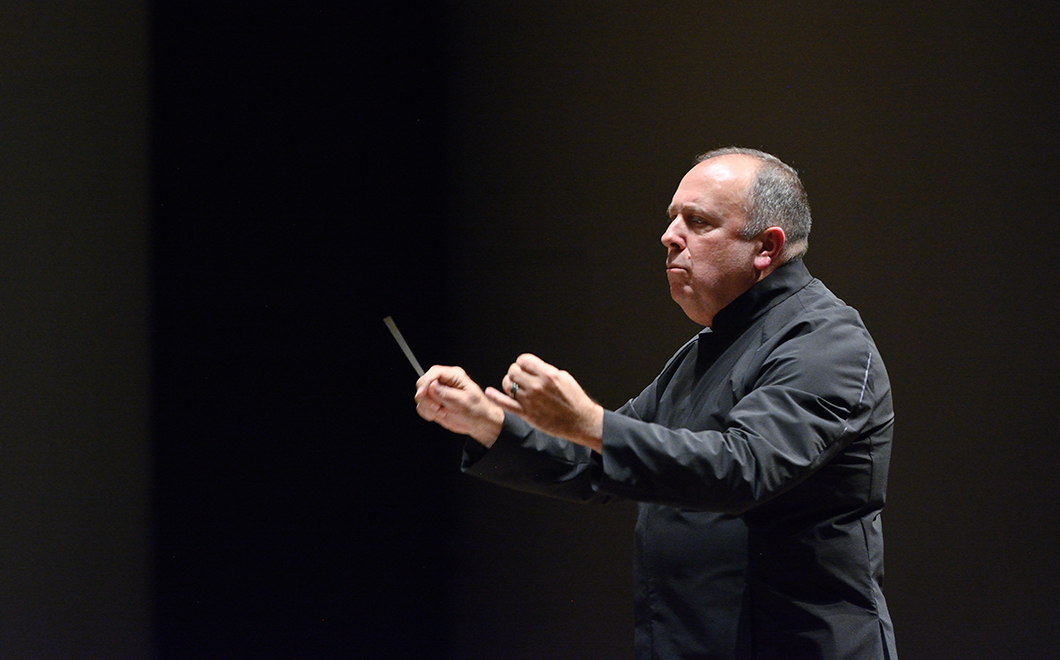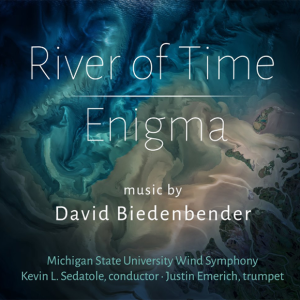
The collaboration between composer David Biedenbender, conductor Kevin Sedatole, soloist Justin Emerich, and the MSU Wind Symphony features two of Biedenbender’s award-winning works.
When the Michigan State University Wind Symphony took the stage at the Wharton Center on March 20, 2025, it wasn’t just another performance—it was the beginning of a recording that would become a testament to the College of Music’s commitment to excellence, collaboration, and student opportunity.
Released in summer 2025, the album David Biedenbender: Enigma. River of Time (Blue Griffin) features two major works by Associate Professor of Composition David Biedenbender: the title piece Enigma and the trumpet concerto River of Time. The recording brings together the talents of three MSU faculty members—Biedenbender, conductor Kevin Sedatole, and trumpet soloist Justin Emerich—alongside the top student musicians of the MSU Wind Symphony.
For Sedatole, MSU’s Director of Bands, the project is part of a long-standing goal.
“One of my goals while at MSU is to make a recording for our faculty composers when they had enough repertoire for band available,” he said. “When [David] won both the Revelli and Ostwald prizes in composition, it really was a no-brainer that we must record.”
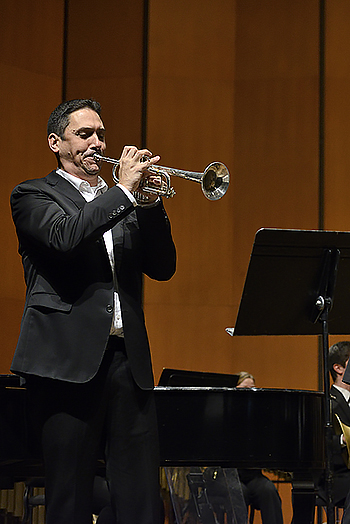
Trumpeter Justin Emerich’s lyrical style is what made MSU Director of Bands Kevin Sedatole realize that David Biedenbender’s River of Time trumpet concerto would be the perfect piece for him to play. His performance is now immortalized on the latest Blue Griffin release.
The album’s centerpiece, River of Time, is a three-movement concerto that explores the nature of time through music. Inspired by philosophical and scientific texts, including Marcus Aurelius’ Meditations and Carlo Rovelli’s The Order of Time, Biedenbender uses the trumpet to navigate themes of becoming, presence, and transcendence.
“David’s trumpet concerto, River of Time, is a fantastic piece that is beautifully written and will hopefully become a staple of our solo repertoire,” said Emerich, professor of trumpet and chair of the Brass Area. “David masterfully writes for a wonderfully balanced concerto between the trumpet and Wind Symphony. It’s just an amazing piece.”
Although the piece was not originally written for Emerich, Sedatole immediately recognized the fit.
“As soon as I heard the premiere by the Lansing Symphony, I knew that Justin needed to play it,” he said. “It really fits his beautiful lyricism and really pure sound.”
The album also includes Enigma, a work originally composed for brass choir and organ and later adapted for wind ensemble. The piece is a tribute to Biedenbender’s late mentor, José-Luis Maúrtua, and draws its theme from Bach’s Passacaglia and Fugue in C minor, unfolding in twenty-one variations.
Sedatole and the Wind Symphony performed Enigma in 2024, but Sedatole said it was a natural decision to revisit the work for the recording “because it is such a terrific piece in terms of orchestration and structure.”
For the students in the Wind Symphony, the recording process offered an opportunity to engage in professional-level music-making.
“It’s all about the process from rehearsal to recording to performance,” Sedatole explained. “We approach every performance with as much detail as we possibly can, but when you record everything becomes more heightened. The awareness of individual and ensemble preparation grows to a higher level.”
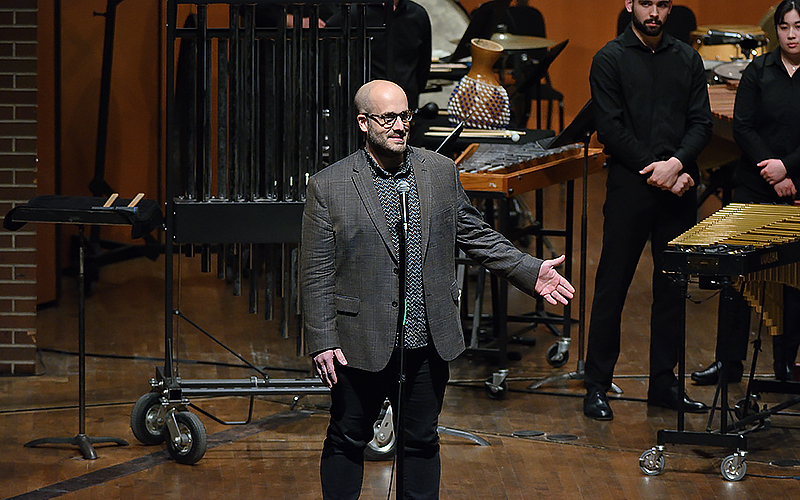
Composer and Chair of MSU Composition David Biedenbender addresses the crowd at a performance 0f his award-winning piece, Enigma.
Biedenbender echoed the value of the recording experience for students. He noted that recording creates opportunities to “craft and capture moments” that may not happen during a live performance.
“Recording lays bare any issues in a performance, so you have to make sure your playing is at the highest possible level when you press record,” he said. “These students rose to the challenge and have made a record that is truly remarkable.”
Beyond the technical demands, the project also served as a model for students in both performance and composition.
“For my composition students, I am always thinking about modeling—a career, a creative practice, teaching,” Biedenbender said. “We talk about not merely trying to replicate my pathway in music, but also using some of what I’ve learned and finding their own models to forge their own path forward.”
Emerich, too, emphasized the value of collaboration. “Collaborating with my colleagues at the MSU College of Music is incredibly rewarding, as is working with my students” he said. “They are my favorite parts of being a professor at MSU.”
In its entirety, the album is more than a collection of performances. It is a snapshot of what makes the MSU College of Music a vibrant and collaborative community.
“It’s really special to make music with friends and colleagues. I work with these wonderful people every day, but making an album like this is a powerful public record of what we do here and why—of what truly brings us together,” Biedenbender said. “I am so proud to share with the world this window into what we do at MSU.”

The Campaign for Michigan State University
Our campaign addresses the most pressing challenges facing the music industry today while increasing our capacity to create lasting positive change and to support student and faculty success.
See Our Campaign Goals