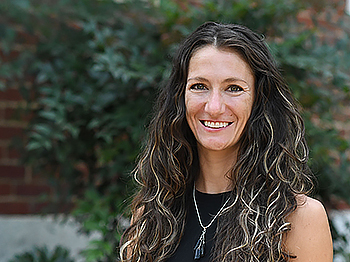
Music alum Dr. Kelli Smith-Biwer is assistant professor of music in the Musicology Department at the University of Michigan School of Music, Theatre, and Dance.
At Michigan State University’s College of Music, the master’s program in musicology is intentionally small yet expansive in meaningful ways. For alumni Kelli Smith Biwer and Jonathan A. Gómez, the small scale meant close mentorship, open doors, and teaching experience that continues to shape their careers long after graduation.
Their professional paths have since taken them into faculty roles at the University of Michigan School of Music, Theatre & Dance, where both now serve as assistant professors of musicology. As teachers, researchers, and advisors, they each draw heavily on the foundation they built during their time at MSU.
“The musicology master’s program at MSU gave me an opportunity to learn from lots of different personalities what it means to be in this career,” Smith Biwer said. “All of the faculty gave me such valuable insights into opportunities that would be available to me after the master’s degree. I think about my MSU mentors constantly when I do research, and that is something that’s a real gift with that program.”
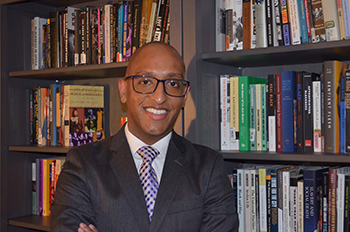
Music alum Dr. Jonathan A. Gómez is assistant professor of music in the Musicology Department at the University of Michigan School of Music, Theatre, and Dance.
Gómez arrived at MSU with a background in jazz saxophone performance from the University of Miami and was drawn to MSU’s synergy between jazz and musicology. He realizes now that while that synergy was meaningful, the teaching experiences he gained at MSU had lasting meaning. During his Ph.D. at Harvard, he was entrusted with a role as head teaching fellow for a large General Education course taught by Professor Alex Rehding.
“The teaching opportunities, to work with different professors in the department – in my case, Sarah Long, Nick Field, Michael Largey, and Ken Prouty – was invaluable,” Gómez said. “I think about them all the time, and I think part of the reason I was able to take that position in my third year at Harvard was because I had teaching experience with large classes at MSU.”

Drs. Jonathan Gómez (left) and Kelli Smith-Biwer met when both were accepted into the intentionally small musicology masters program where they worked with several professors including now retired Bruce Taggart (right).
Classroom experience was equally impactful for Smith-Biwer. The autonomy to lead undergraduate discussions at MSU gave her a level of preparedness that surpassed many of her peers during her doctoral study.
“It was such a formative experience, and those are skill sets that I had going into my Ph.D. program that most folks did not have,” she said. “I knew how to lead an undergraduate discussion with twenty-five students for an hour, which is not easy. It was really useful, and I am only coming to appreciate it now.”
Prouty, professor of musicology and jazz studies, said this kind of preparation is intentional. The area aims to build broadly capable scholars equipped for varied careers.
“Ultimately, I think we want to provide students with a background for further work, whether it be in musicology or other related field,” he said. “We’ve had a good track record of sending students on to advanced Ph.D. programs, and to positions in the field.”
He added that in addition to the teaching opportunities, the program’s interdisciplinary openness reflects the direction of the field.
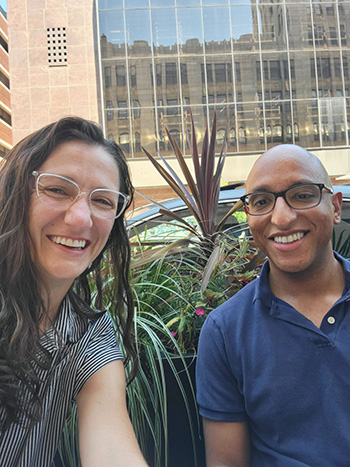
Drs. Kelli Smith-Biwer and Jonathan reunited in 2025 as members of the University of Michigan music faculty.
“The fields of historical musicology and ethnomusicology have changed tremendously since I was a grad student in the late 1990s,” Prouty said. “We take great care that our students are not siloed into a particular approach or perspective.”
Professor of Musicology and Chair of the Musicology/Ethnomusicology Area Kevin Bartig explained that such focus and the program’s scale are its strengths. Its small size allows for individualized mentorship tailored to each student’s goals.
“Our master’s program is quite small by design. We’re able to devote a lot of time to one on one advising,” he said.
Bartig noted that Smith Biwer entered MSU with momentum and curiosity that helped propel her into a top doctoral program.
“Kelli is deeply curious by nature,” he said. “She came to MSU already having made deep dives into potential research topics, so she was really able to hit the ground running.”
He also points to her habit of seeking opportunities beyond standard requirements such as collaborating with composers, performing, and letting her research interests intersect creatively across projects.
“As a student, Kelli was someone who always thought about the big picture,” Bartig said.
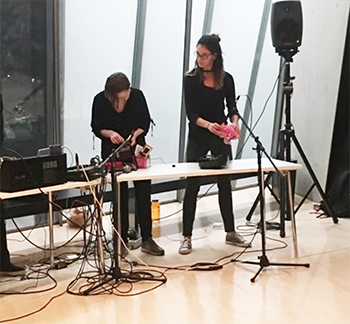
Kelli Smith-Biwer used the freedom provided in the MSU Musicology masters program to connect with colleagues in Composition and continue to write and perform electronic music.
Smith Biwer’s journey back to scholarship included time away from music during the 2012 recession, only to return with clarity about her interest in history, media, and technology. She explained that she found pivotal guidance from Bartig while at MSU and credits him – and later Mark Katz during her Ph.D. – with shaping the way she thinks and writes.
“Kevin’s focus on media studies and film history has really driven the media studies side of what I do. And now I consider myself much more of a media studies person than really anything else,” she said. “He’s an unbelievable writer. When it comes to the writers that I’ve worked with, I’ve been really spoiled working with Kevin Bartig and then Mark Katz. These are two people who really demand rhetorical clarity, and that’s something I really prize about my own writing now.”
Prouty said that in Gómez he found an artist scholar whose combined strengths mirrored his own experience as a jazz performer and academic researcher.

Dr. Jonathan Gómez (left) in 2018 with the esteemed MSU faculty on his master’s committee (from left) Michael Largey, Kenneth Prouty, Rodney Whitaker, and David Stowe.
“As strong as his scholarship is – and it is very strong – he has never lost sight of being a jazz player at his core,” Prouty said. “A lot of times, we use the phrase ‘artist scholar’ in cliched ways, but he really does embody that idea. I regard my time with him as some of the most rewarding in my entire career.”
The appreciation is mutual. With time to reflect on their master’s program at MSU, Smith-Biwer and Gómez have come to the same conclusion: the MSU musicology master’s program gave them skills but also a model of mentorship, intellectual generosity, and community that continues to inform their work.

